
SAC Codes for Freelancers in India: Find the Right One for Your Service (2026)
SAC codes for Indian freelancers explained: what they are, commonly used codes for developers, designers and marketers, and how to verify the right one for your service.
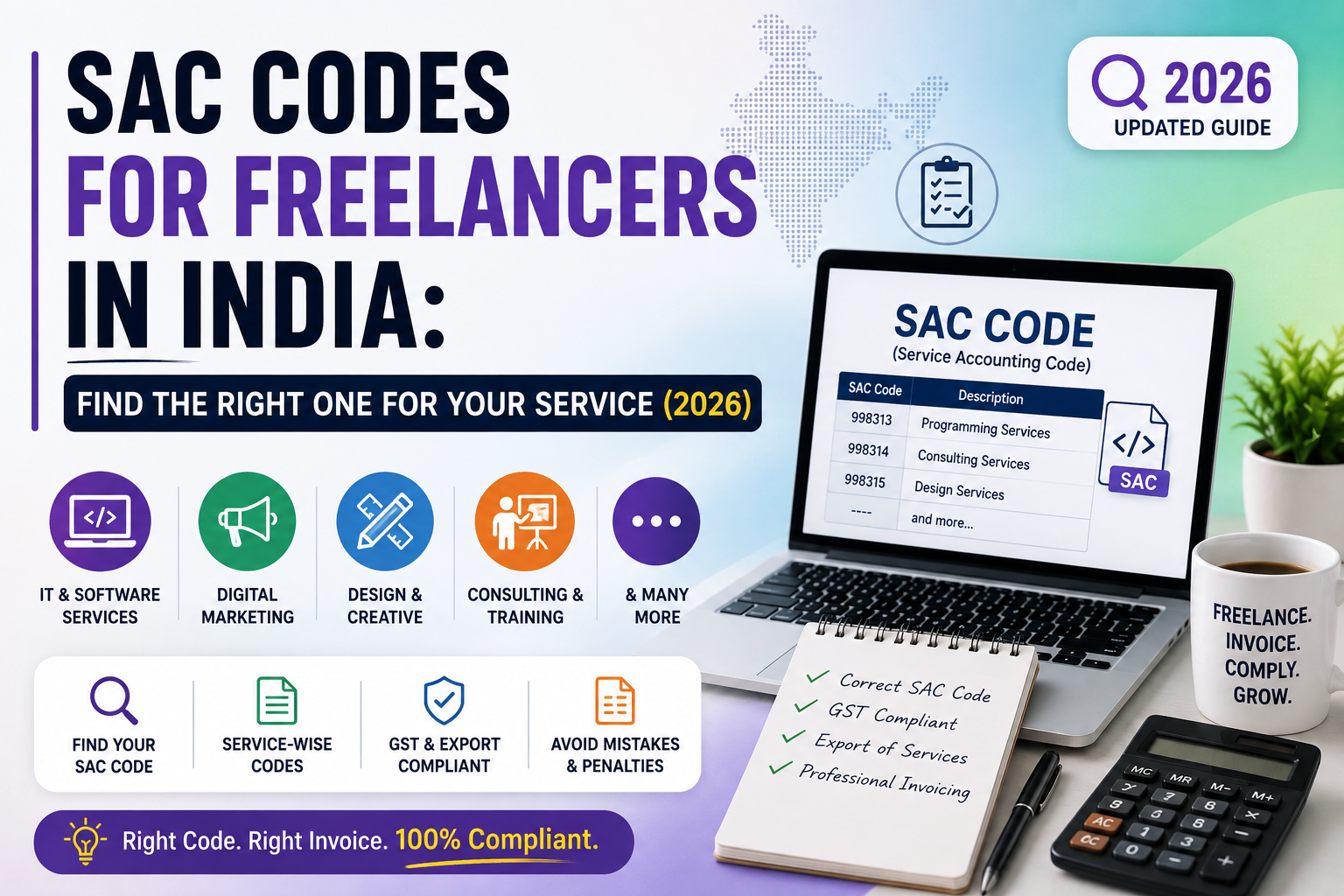
- What Exactly Is a SAC Code?
- Why It Matters More Than It Seems
- Commonly Used SAC Codes for Freelancers
- How to Verify Your Code (Instead of Trusting a Blog)
- SAC Codes and Your Rate
- Common Mistakes
- FAQ
- Is a SAC code mandatory on my invoice?
- What's the difference between SAC and HSN?
- Can I just use 998399 for everything?
- Does the SAC code change my GST rate?
- What if I picked the wrong SAC code on past invoices?
- Set It Once, Never Retype It
You're filling out your first GST invoice, everything's going smoothly, and then you hit a field that stops you cold: SAC code. Six digits that apparently describe what you do for a living. Pick from where? Google throws up conflicting lists, and half the blogs contradict each other. Let's fix that properly — including how to verify your code instead of trusting a random table on the internet (yes, including this one).
Quick answer: SAC (Services Accounting Code) is a six-digit classification code for services under GST, and most freelance services fall under the 9983 family — "other professional, technical and business services." Your SAC code appears on your GST invoices and in your returns, and most freelance services classified here generally attract 18% GST when taxable (exports being zero-rated with a LUT).
Note: classifications and rate schedules are maintained by the government and can be updated. Treat every code in this article as a starting point to verify on the GST portal or with your CA — not a final answer.
What Exactly Is a SAC Code?
SAC stands for Services Accounting Code — the service-side counterpart of the HSN codes used for goods. The structure is logical:
- 99 — the prefix all services share
- Next two digits — the service group (e.g., 83 for professional/technical/business services)
- Last two digits — the specific service within that group
So in 998314: 99 = service, 83 = professional/technical/business services, 14 = IT design and development. Once you see the structure, the six digits stop looking random.
Why It Matters More Than It Seems
Your SAC code isn't decorative. It shows up in at least three places:
- Your invoices. GST-registered suppliers are generally required to mention SAC codes on tax invoices — how many digits can depend on your turnover, so check the current requirement that applies to you. Export invoices should carry the code too, alongside the LUT declaration (export invoice format here).
- Your returns. GSTR-1 generally includes a SAC-wise summary of outward supplies (GSTR-1 walkthrough).
- Your registration. The services you declared while registering are classified by these codes — your invoices and returns should tell the same story.
Inconsistency across these three is the kind of small mismatch that creates large annoyances later.
Commonly Used SAC Codes for Freelancers
These are the codes most commonly associated with typical freelance services. Confirm the right one for your specific work before using it — service descriptions matter more than job titles.
| Your work | Commonly used SAC | Classification description |
|---|---|---|
| Software / app development | 998314 | IT design and development services |
| IT consulting, tech support | 998313 | IT consulting and support services |
| Website hosting, infra management | 998315 | Hosting and IT infrastructure services |
| Management / business consulting | 998311 | Management consulting services |
| Graphic design, UI/UX, branding | 998391 | Specialty design services |
| Advertising, campaign management | 998361 | Advertising services |
| Selling online ad space / placements | 998365 | Sale of internet advertising space |
| Photography / videography | 99838 group | Photography and videography services |
| Anything that fits nowhere else | 998399 | Other professional, technical and business services n.e.c. |
A few honest notes on this table:
- Writers, SEO specialists, virtual assistants, and "hybrid" freelancers often don't have one obvious code. Depending on the actual nature of the work, classifications can differ — an SEO retainer might reasonably sit differently than a content-writing contract. This is exactly where a 10-minute CA conversation earns its fee.
- 998399 is the catch-all, and it's legitimately used — but defaulting to it for everything when a more specific code clearly fits isn't great practice.
- Your job title doesn't decide the code; the service description does. A "designer" doing front-end development is closer to 998314 than 998391 for that engagement.
How to Verify Your Code (Instead of Trusting a Blog)
- GST portal lookup. The portal has a services classification search — search by service description and read the official descriptions.
- Check your GST registration. The classifications you selected at registration are on record; align with them or update them if your work has changed.
- Look at what established peers/agencies in your exact niche use — useful signal, not proof.
- Ask your CA once, use it forever. For most freelancers the code doesn't change month to month; it's a one-time decision worth making properly.
SAC Codes and Your Rate
Most freelance professional services under the 9983 family generally attract 18% GST when the supply is taxable in India. When you're exporting services with a valid LUT, the supply is zero-rated — the SAC code still goes on the invoice, but no tax is charged (how that works). If you're not GST-registered at all (under the threshold), SAC codes don't apply to your invoices yet — here's when registration becomes relevant.
Common Mistakes
- Copying a code from a blog without reading the classification description. Including this blog. Read the description; make sure it describes your work.
- Using different codes on invoices vs returns. Pick once, stay consistent everywhere.
- Using an HSN goods code for a service. If you sell both (say, a designer selling art prints), goods and services classify separately.
- Never revisiting the code as your work evolves. The freelancer who started with content writing and now runs paid ads is likely providing a different service class than three years ago.
FAQ
Is a SAC code mandatory on my invoice?
For GST-registered suppliers, mentioning SAC on tax invoices is generally required, with the number of digits linked to turnover rules. If you're unregistered (under the threshold), your simple invoices don't carry GST fields at all.
What's the difference between SAC and HSN?
HSN classifies goods; SAC classifies services. Freelancers supplying services use SAC. Both systems can appear in the same GST return if you supply both.
Can I just use 998399 for everything?
It's the genuine catch-all and it's used widely, but if a specific code clearly matches your service, prefer the specific one. Consistency and defensibility beat convenience.
Does the SAC code change my GST rate?
The rate flows from the classification, and most professional services in the 9983 family generally sit at 18% when taxable. A few service categories elsewhere carry different rates — one more reason to classify correctly.
What if I picked the wrong SAC code on past invoices?
Don't panic and don't hide it — correct it going forward and ask your CA whether anything needs amending in returns. Consistent good-faith classification matters more than perfection.
This article is for general education, not professional tax, legal, or financial advice. Service classifications and rate schedules are updated by the government from time to time — verify current codes and rates on the official GST portal or with a qualified CA before finalising your invoices.
Set It Once, Never Retype It
The right SAC code is a one-time decision — retyping it correctly on every invoice is the part people mess up. Zolance saves your service items with their SAC codes, so every invoice you generate — domestic or export — carries the right code, the right declaration, and the right format automatically.